The facility - A 1 GW plant on the Namibian coast
Insola is developing an integrated n-type bifacial IBC solar cell and module manufacturing facility in Namibia, at an annual capacity of 1 GW. The concept design is complete, the electrical and water demand is estimated at design-concept level, and candidate sites are under evaluation in the coastal corridor serving the Port of Walvis Bay. Site selection, permitting and financial close still lie ahead.
Designed for the operating conditions
A manufacturing plant on the Namibian coast, producing bifacial modules specified for high-irradiance, high-albedo installation conditions.
1 GW, cells and modules
An integrated plant producing both n-type bifacial IBC cells and the finished modules, at an annual capacity of 1 GW. Making the cell and the module on one site captures the margin on both, and the plant is designed to meet the domestic value-addition thresholds that regional rules of origin apply.
A manageable electrical load
The 1 GW figure is annual module output: roughly two million 600 W modules a year. The plant’s own peak electrical demand is a separate and much smaller quantity, put by design work to date on the order of 15 to 25 MW, connected as a transmission-level maximum-demand customer, with captive solar on the site an option.
Industry 4.0 instrumentation
Automated optical and electroluminescence inspection, machine-learning quality control and full material traceability across the line.
Existing plant design
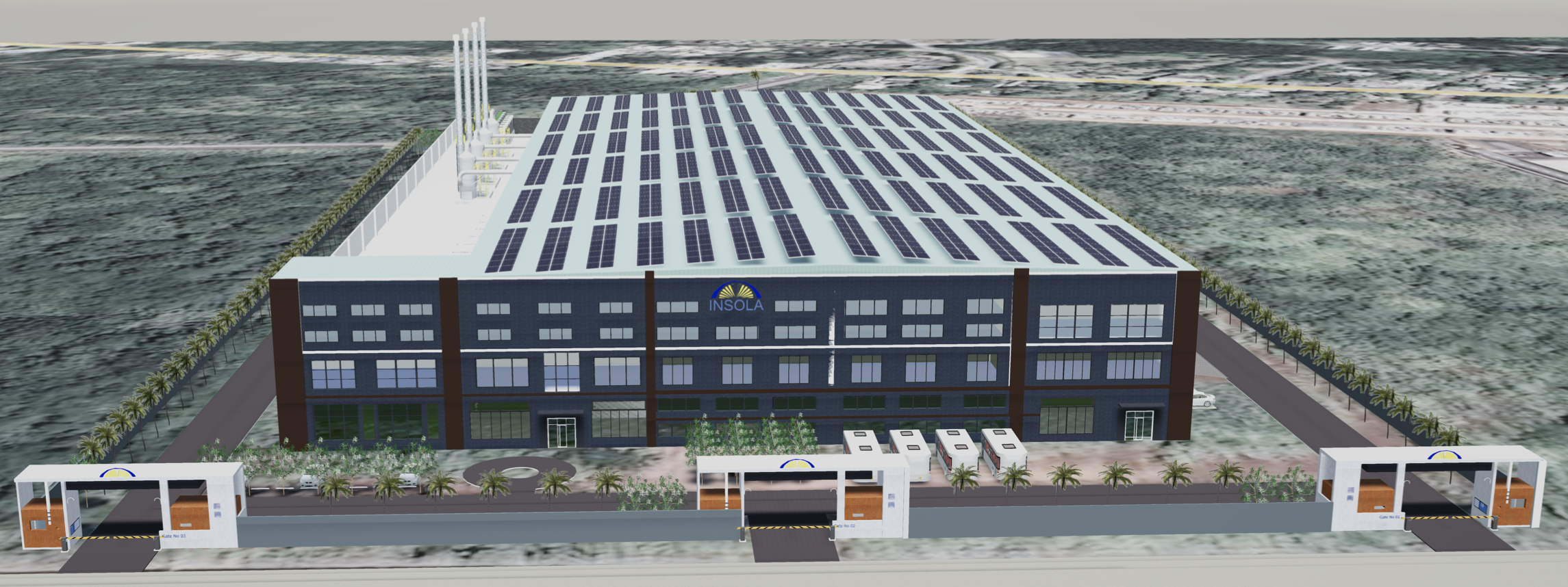
The plant follows a completed concept design for a 35,000 m² manufacturing building, prepared by the German engineering house that provided engineering and project management on the Kalyon PV facility in Turkey. Namibia builds it single-storey where land allows.
The site - Site selection and land
The requirement is roughly 100 hectares. The manufacturing building itself is 35,000 m²; the balance covers logistics and storage buildings, material flow, turning circles for heavy vehicles and land for captive solar generation. Rail is a design requirement: the site must be served by a siding with a direct route to the Port of Walvis Bay, because the modules are made for export as well as for the domestic and regional market. Candidate locations in the coastal corridor are under evaluation against that requirement, alongside power, water and industrial-land availability. No site is secured.
- Annual cell and module capacity
- 1 GW
- Manufacturing building footprint
- 35,000 m²
- Total site requirement
- ~100 ha
- Projected project investment
- USD 180m
Utilities - Power, water and connection
The plant connects at transmission level and is billed on a nominated maximum demand. Design work to date puts that peak on the order of 15 to 25 MW, a figure that will be confirmed through detailed engineering and in consultation with NamPower and the Electricity Control Board. The design provides for roof-mounted and ground-mounted generation on the site to offset part of the daytime load and reduce grid draw over time, using a solar resource among the highest in the world.
Potable water demand is specified in the facility design concept. Cell and module manufacturing uses water in process rinsing and cooling rather than as feedstock, and the design provides for on-site storage and recycling. Water availability is one of the criteria the candidate sites are assessed against, alongside the established industrial water infrastructure of the coastal corridor.
Logistics - Rail, port and regional market access
Walvis Bay is Namibia’s largest port and a regional trade gateway, served by road and rail corridors into South Africa, Angola, Botswana and Zambia. Namibia has the best road network on the African continent according to the World Economic Forum, and the national rail line is being extended and rehabilitated to improve the Walvis Bay connection to neighbouring countries. A NAD 40 billion expansion of the Walvis Bay and Lüderitz ports is planned. Namibia’s investment board describes the country as a gateway to the Sub-Saharan region and cites that logistics position as the reason a Namibian plant can serve African markets through export.
Equipment arrives by sea and is trucked or railed to site. Modules leave the same way. Every candidate site is assessed against the requirement for a rail-served parcel with a direct link to the port.
The build - How the plant gets built
The concept design is complete: a 35,000 m² facility with the production lines, equipment specification and material flow already laid out. The base design is double-storey. Where the site allows the footprint, the Namibian plant is built single-storey, which is simpler to construct and cheaper per square metre. The financial model assumes a 54-week construction period followed by a 15-week equipment installation and commissioning period. Environmental and permitting studies begin once the site is confirmed.
Engineering is provided by a German owner’s-engineering and technology-integration house for the solar industry, whose reference projects include the Kalyon PV facility in Turkey. Namibian multi-disciplinary engineering and project-management capability covers site due diligence, geotechnical and flood-risk assessment, utility capacity studies, the construction execution plan and the contractor tender packages. The difference from Kalyon is the cell: polyZEBRA n-type back contact from ISC Konstanz, in place of the p-type PERC used at Kalyon.
What it builds locally - Jobs, skills and the local value chain
The plant is expected to support around 350 permanent roles at full operation, running three shifts, with 2,000 to 3,000 jobs during the construction phase. The plant makes its own cells rather than importing finished cells to assemble, so the roles include cell process engineering, metrology, automation and maintenance alongside module assembly. The technology transfer covers training of the workforce through to full-capacity ramp-up. The plant also draws on a supplier and services value chain in logistics, maintenance, fabrication and glass and frame supply.
- Permanent positions at full operation
- ~350
- Jobs during construction
- 2,000–3,000
- Continuous operation
- 3 shifts
Capacity, load, workforce and investment figures are indicative and will be confirmed through detailed engineering, site selection and feasibility.
The technology the plant manufactures
Read the cell and module specifications, or get in touch.