High-tech solar manufacturing in Namibia.
Insola is developing a 1 GW n-type IBC bifacial solar PV cell-and-module plant in Namibia, built on proven German cell technology already in commercial production at scale, by the same engineering partners, in China and Lithuania.
The opportunity - Why Namibia
Namibia has the irradiance, a deep-water port with corridors into four neighbouring markets, and a government that has asked in writing for a solar PV manufacturing plant. Very few places have all three.
Solar resource
Namibia records an average high direct insolation of 2,200 kWh/m² a year with minimal cloud cover, and up to 3,000 kWh/m² in the south. The country’s investment board puts the yield of a Namibian PV system at twice that of a comparable system in central Europe.
Location and logistics
Walvis Bay is Namibia’s largest port and the gateway to the region, with paved corridors into South Africa, Angola, Botswana and Zambia, and a rail extension toward Botswana planned. Namibia holds SACU and SADC Free Trade Area membership and AGOA access.
A named national priority
Namibia’s investment board has published a written proposition seeking exactly this facility, and the National Planning Commission names solar panel manufacturing first among the green industrial sectors the government is targeting. Cabinet approved a Green Industries Council in May 2026.
Established cell technology
The plant is built on an established German n-type IBC cell technology, transferred to commercial production lines in China and Lithuania by the same engineering partners and in mass production since 2020.
- Annual production capacity
- 1 GW
- Solar yield vs central Europe
- 2×
- Namibian solar pipeline, 4 to 5 years
- 3.1 GW
- Renewables target by 2030
- 70%
Solar-resource figures per the National Integrated Resource Plan 2022, Ministry of Mines and Energy, and the Namibia Investment Promotion and Development Board. The renewables target is a national target for 70% of electricity generated in Namibia, per the National Energy Compact. The pipeline figure is the NIPDB’s estimate of installed solar capacity over the next four to five years. Forward-looking project details on this site are indicative.
Where we are - From concept to production
Every Insola project moves through the same five stages, from first look to full production. In Namibia, the concept and the financial model are settled and the project is being structured: the project company is being established, the technology licence is in negotiation and development capital is being raised. Site, permits, financing and construction are the work ahead.
- Complete
Stage 1
Concept & feasibility
- A 1 GW integrated cell-and-module plant defined, on German n-type IBC technology
- A Namibian financial model built and locked, and the plant’s electrical load quantified
- Namibia assessed and selected as the site for the group’s southern African plant
- We’re here
Stage 2
Development & structuring
- The Namibian project company being established, with the name reserved and statutory filings lodged
- The master technology licence for sub-Saharan Africa in advanced negotiation with ISC Konstanz
- Development capital being raised, and a shortlist of coastal sites under evaluation
- Engagement under way with the Namibia Investment Promotion and Development Board and the National Planning Commission
- Ahead
Stage 3
Site, permits & definitive agreements
- Securing the site and concluding the definitive shareholder and licence agreements
- Environmental and permitting studies, to commence once the site is confirmed
- Detailed engineering design and the tendering of contractor packages
- Ahead
Stage 4
Financing & financial close
- Assembling the project capital stack of approximately US$180 million
- Financial close targeted in 2027, with construction to follow
- Ahead
Stage 5
Construction & production
- A 54-week construction period, then equipment installation and commissioning
- n-type IBC cells and modules coming off a Namibian line
The technology - Proven German n-type IBC cells
The cell technology is ZEBRA, developed by ISC Konstanz in Germany and running in commercial-scale plants in China and Lithuania, built by the same engineering partners the Namibian plant will use.
High conversion efficiency
n-type IBC cells reaching around 25% conversion, against roughly 22% for mainstream cells, and module efficiency up to 24.6%. The same area yields a 600 W-class module.
Bifacial energy gain
All contacts sit on the rear face, so there is no front-side shading and the module generates from both sides. Rear-side gain runs 10% to 20% under typical conditions, and exceeds 20% on high-albedo desert ground.
Built for hot, bright climates
n-type silicon resists PID, LID and LeTID degradation, with a low temperature coefficient of −0.26%/K. Three years of desert testing in Dubai returned 0.4% annual degradation.
All-black module face
With no busbars on the front, the module reads as a single black plane. It suits roofs and facades where appearance matters.
Bifacial gain assumes ground albedo above 25%, a module mounting height of 1.5 m and a ground cover ratio of no more than 40%, on a mounting structure that does not obstruct the module rear side.
The cell technology has been transferred into industrial production twice before.
ISC Konstanz transferred the ZEBRA cell to commercial production in China in 2020 and Lithuania in 2021. The Chinese line has since run at an average cell efficiency of 24.2%, and its modules carry IEC certification. The equipment set is defined, the supplier base is established, and the plant design has been through concept design with a German solar manufacturing engineering firm. Namibia imports the modules this plant makes.
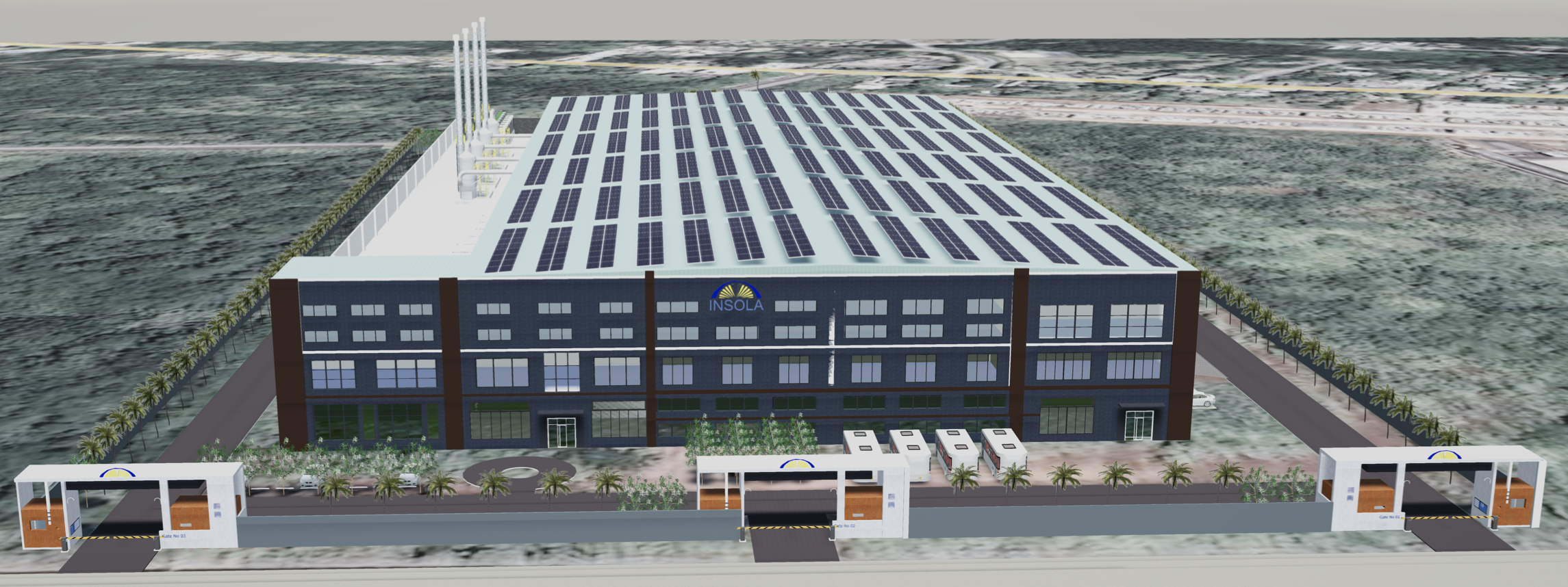
The plant
A 1 GW integrated cell-and-module facility in a 35,000 m² single-storey building, designed to modern Industry 4.0 standards, on a rail-served coastal site with direct access to the Port of Walvis Bay for export.
Explore the conceptA Namibian project company, a Namibian partner, German technology.
Insola Manufacturing Namibia is the project company being established in Namibia to build and operate the plant. Its shareholders are Solunex Group Limited, the Insola group holding company, and a Namibian industrial partner. The plant will manufacture under a sub-licence granted by EquuSol Limited, the group’s technology and brand holding company, with the consent of the German technology owner.
What the plant brings to Namibia
Cell and module manufacturing
Cells and modules are made under one roof. Namibia’s investment board recommends an assembly plant with at least two locally manufactured input components as an entry strategy. This design goes beyond that, and is built to meet the SADC value-addition rules of origin that confer Namibian origin and duty-free regional access.
Skilled industrial jobs
Around 350 permanent roles across three shifts once the plant is complete, with 2,000 to 3,000 downstream jobs during construction. Technical training and skills transfer run alongside the technology transfer from Germany.
Supply into local demand
Namibia imported N$1.51 billion of solar panels in 2023, up from N$577.8 million in 2022, and the electricity regulator has approved 649 MW of solar generation licences that are not yet built. The plant supplies the modules that build them.
In partnership with
EquuSol
Licensing partner, the group’s technology and intellectual-property holding company and owner of the Insola brand, incorporated in Mauritius. The Namibian sub-licence for the cell technology would be granted by EquuSol in cooperation with the German technology owner and subject to its consent.
ISC Konstanz
The German non-profit solar research institute that developed the ZEBRA n-type back-contact cell technology and is the technology partner to the group. Established in 2005 as a spin-off from the University of Konstanz, it employs around 60 engineers and technical specialists. A master licence agreement covering sub-Saharan Africa is in negotiation with EquuSol.